Classical conditioning
Classical conditioning (also Pavlovian conditioning or respondent conditioning) is a form of learning in which the conditioned stimulus or CS, comes to signal the occurrence of a second stimulus, the unconditioned stimulus or US. (A stimulus is a factor that causes a response in an organism.) The conditioned response is the learned response to the previously neutral stimulus. The US is usually a biologically significant stimulus such as food or pain that elicits a response from the start; this is called the unconditioned response or UR. The CS usually produces no particular response at first, but after conditioning it elicits the conditioned response or CR. Classical conditioning differs from operant or instrumental conditioning, in which behavior emitted by the subject is strengthened or weakened by its consequences (i.e. reward or punishment)
There are many examples of these innate (unconditioned) reflexes (corneal, coughing, swallowing, withdrawal reflexes etc.) or learned (conditioned) reflexes.
"In any animal, regardless of its prior history, painful stimulation of the foot causes the leg to be withdrawn by bending at all its joints. This flexor reflex is an example of an unconditioned reflex, an innate response based on fixed connections in the chain of neurons from the receptor (sensor) to the effector. Of still more interest in everyday life are the acquired or conditioned reflexes, in which the functional connections between the excited sensors and the patterns of activity in effector organs become established by learning process."
Conditioning is usually done by pairing the two stimuli, as in Pavlov’s classic experiments. Pavlov presented dogs with a ringing bell followed by food. The food elicited salivation (UR), and after repeated bell-food pairings the bell also caused the dogs to salivate. In this experiment,the unconditioned stimulus is the dog food as it produces an unconditioned response, saliva. The conditioned stimulus is the ringing bell and it produces a conditioned response of the dogs producing saliva.
It was originally thought that the process underlying classical conditioning was one where the conditioned stimulus becomes associated with, and eventually elicits, the unconditioned response. But many observations do not support this hypothesis. For example, the conditioned response is often quite different from the unconditioned response. Learning theorists now more commonly suggest that the CS comes to signal or predict the US. In the case of the salivating dogs in Pavlov's experiment, the bell tone signaled and predicted the arrival of the dog food, thus resulting in the dog salivating. Robert A. Rescorla provided a clear summary of this change in thinking, and its consequences, in his 1988 article "Pavlovian conditioning: It's not what you think it is."
Origins
I. P. Pavlov provided the most famous example of classical conditioning, though E. B. Twitmyer published his findings a year earlier (a case of simultaneous discovery). During his research on the physiology of digestion in dogs, Pavlov noticed that, rather than simply salivating in the presence of food, the dogs began to salivate in the presence of the lab technician who normally fed them. Pavlov called this anticipatory salivation psychic secretion. From this observation he predicted that, if a particular stimulus in the dog's surroundings was present when the dog was given food, then this stimulus would become associated with food and cause salivation on its own. In his initial experiment, Pavlov used a bell to call the dogs to their food and, after a few repetitions, the dogs started to salivate in response to the bell. Pavlov called the bell the conditioned (or conditional) stimulus (CS) because its effect depended on its association with food. He called the food the unconditioned stimulus (US) because its effect did not depend on previous experience. Likewise, the response to the CS was the conditioned response (CR) and that to the US was the unconditioned response (UR). The timing between the presentation of the CS and US is integral to facilitating the conditioned response. Pavlov found that the shorter the interval between the bell's ring and the appearance of the food, the more quickly the dog learned the conditioned response and the stronger it was.
As noted earlier, it is often thought that the conditioned response is a replica of the unconditioned response, but even Pavlov noted that saliva produced by the CS differs in composition from that produced by the US. In fact, the CR may be any new response to the previously neutral CS that can be clearly linked to experience with the conditional relationship of CS and US. It was also thought that repeated pairings are necessary for conditioning to emerge, however many CRs can be learned with a single trial as in fear conditioning and taste aversion learning.
Classical conditioning procedures
Forward conditioning
Learning is fastest in forward conditioning. During forward conditioning the onset of the CS precedes the onset of the US in order to signal that the US will follow. Two common forms of forward conditioning are delay and trace conditioning.
- Delay conditioning: In delay conditioning the CS is
presented and is overlapped by the presentation of the US.
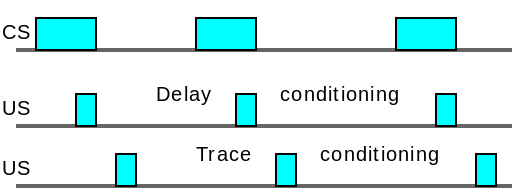
- Trace conditioning: During trace conditioning the CS and US do not overlap. Instead, the CS is presented, a period of time is allowed to elapse during which no stimuli are presented, and then the US is presented. The stimulus-free period is called the trace interval. It may also be called the conditioning interval.
Simultaneous conditioning
During simultaneous conditioning, the CS and US are presented and terminated at the same time.
Second-order conditioning
Main article: Second-order conditioning
This form of conditioning follows a two-step procedure. First a neutral stimulus (“CS1”) comes to signal a US through forward conditioning. Then a second neutral stimulus (“CS2”) is paired with the first (CS2-CS1) and comes to yield its own conditioned response. For example, a bell (CS1) might paired with food (US) until the bell elicits salivation. If a light is then paired with the bell the light also may come to elicit salivation.
Backward conditioning
Backward conditioning occurs when a CS immediately follows a US. Unlike the usual conditioning procedure, in which the CS precedes the US, the conditioned response given to the CS tends to be inhibitory. This presumably happens because the CS serves as a signal that the US has ended, rather than as a signal that the US is about to appear.
Temporal conditioning
When a US is presented at a number of regularly timed intervals a CR often develops shortly before the US is scheduled to appear. This suggests that animals have a biological clock that can serve as a CS. This method has also been used to study timing ability in animals. (see Animal cognition).
Zero contingency procedure
In this procedure, the CS is paired with the US as usual, but the US also occurs at other times, so that the US is just as likely to happen in the absence of the CS as it is following the CS. Here, in other words, the CS does not "predict" the US. In this case, conditioning fails: the CS does not come to elicit a CR.[ This finding - that prediction rather than CS-US pairing is the key to conditioning - greatly influenced subsequent conditioning research and theory.
Extinction
Main article: Extinction (psychology)
In the extinction procedure, the CS is presented repeatedly in the absence of a US. This is done after a CS has been conditioned by one of the methods above. When this is done the CR frequency eventually returns to pre-training levels. However, spontaneous recovery (and other related phenomena, see "Recovery from extinction" below) show that extinction does not completely eliminate the effects of the prior conditioning.