Chromosomes
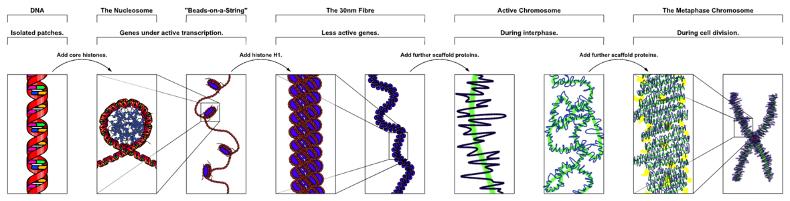
Chromosomes are long pieces of DNA found in the center (nucleus) of cells. DNA is the material that holds genes. It is considered the building block of the human body.
Information
Chromosomes come in pairs. Normally, each cell in the human body has 23 pairs of chromosomes (46 total chromosomes). Half come from the mother; the other half come from the father.
Two of the chromosomes (the X and the Y chromosome) determine if you are born a boy or a girl (your gender). They are called sex chromosomes:
- Females have 2 X chromosomes.
- Males have 1 X and 1 Y chromosome.
The mother always contributes an X chromosome to the child. The father may contribute an X or a Y. Therefore, it is the father that determines the gender of the child.
The remaining chromosomes are called autosomal chromosomes. They are known as chromosome pairs 1 through 22.

Humans have 22 chromosome pairs and two sex chromosomes. Females have two X chromosomes; males have an X chromosome and a Y chromosome.
Humans have 46 chromosomes. There are a total of 23 pairs of chromosomes or 46 total chromosomes. Chromosomes are made up of long strands of DNA which contain all the body genes.
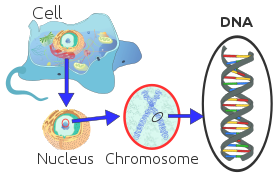
Chromosomes are thread-like molecules that carry hereditary information for everything from height to eye color. They are made of protein and one molecule of DNA, which contains an organism’s genetic instructions, passed down from parents. In humans, animals, and plants, most chromosomes are arranged in pairs within the nucleus of a cell. Humans have 22 of these chromosome pairs, called autosomes.
How sex is determined
Humans have an additional pair of sex chromosomes for a total of 46 chromosomes. The sex chromosomes are referred to as X and Y, and their combination determines a person’s sex. Human females have two XX chromosomes while males possess an XY pairing. This XY sex-determination system is found in most mammals as well as some reptiles and plants.
Whether a person has XX or XY chromosomes is determined when a sperm fertilizes an egg. Unlike the body’s other cells, the cells in the egg and sperm — called gametes or sex cells — possess only one chromosome. Gametes are produced by meiosis cell division, which results in the divided cells having half the number of chromosomes as the parent, or progenitor, cells. In the case of humans, this means that parent cells have two chromosomes and gametes have one.
During fertilization, gametes from the sperm combine with gametes from the egg to form a zygote. The zygote contains two sets of 23 chromosomes, for the required 46.
All of the gametes in the mother’s eggs possess X chromosomes. The father’s sperm contains about half X and half Y chromosomes. The sperm are the variable factor in determining the sex of the baby. If the sperm carries an X chromosome, it will combine with the egg’s X chromosome to form a female zygote. If the sperm carries a Y chromosome, it will result in a male.
The structure of X and Y chromosomes
While the chromosomes for other parts of the body are the same size and shape — forming an identical pairing — the X and Y chromosomes have different structures.
The X chromosome is significantly longer than the Y chromosome and contains hundreds more genes. Because the additional genes in the X chromosome have no counterpart in the Y chromosome, the X genes are dominant. This means that almost any gene on the X, even if it is recessive in the female, will be expressed in males. These are referred to as X-linked genes. Genes found only on the Y chromosome are referred to as Y-linked genes, and expressed only in males. Genes on either sex chromosome can be called sex-linked genes.
There are approximately 1,098 X-linked genes, though most of them are not for female anatomical characteristics. In fact, many are linked to disorders such as hemophilia, Duchenne muscular dystrophy, fragile-X syndrome, and more. They are responsible for red-green color blindness, considered the most common genetic disorder and found most often in males. The non-sex feature X-linked genes are also responsible for male pattern baldness.
In contrast to the large X chromosome, the Y chromosome contains only 26 genes. Sixteen of these genes are responsible for cell maintenance. Nine are involved in sperm production, and if some are missing or defective it can cause low sperm counts or infertility. One gene, called the SRY gene, is responsible for male sexual traits. The SRY gene triggers the activation and regulation of another gene, found on a non-sex chromosome, called the Sox9. The Sox9 triggers the development of non-sexed gonads into testes instead of ovaries.
Sex chromosome abnormalities
Abnormalities in the sex chromosome combination can result in a variety of gender-specific conditions that are rarely lethal.
Female abnormalities result in Turner syndrome or Trisomy X. Turner syndrome occurs when females have only one X chromosome instead of two. Symptoms include failure of the sex organs to normally mature leading to infertility, small breasts, and no menstruation; short stature; a wide, shield-shaped chest; and a wide, webbed neck.
Trisomy X syndrome is caused by three X chromosomes instead of two. Symptoms include tall stature, speech delays, premature ovarian failure or ovarian abnormalities, and weak muscle tone—although many girls and women exhibit no symptoms.
Males can be affected by Klinefelter syndrome. Symptoms include breast development, abnormal proportions such as large hips, tall height, infertility, and small testicles.
Human chromosomes
Chromosomes in humans can be divided into two types: autosomes and sex chromosomes. Certain genetic traits are linked to a person's sex and are passed on through the sex chromosomes. The autosomes contain the rest of the genetic hereditary information. All act in the same way during cell division. Human cells have 23 pairs of chromosomes (22 pairs of autosomes and one pair of sex chromosomes), giving a total of 46 per cell. In addition to these, human cells have many hundreds of copies of the mitochondrial genome. Sequencing of the human genome has provided a great deal of information about each of the chromosomes. Below is a table compiling statistics for the chromosomes, based on the Sanger Institute's human genome information in the Vertebrate Genome Annotation (VEGA) database. Number of genes is an estimate as it is in part based on gene predictions. Total chromosome length is an estimate as well, based on the estimated size of unsequenced heterochromatin regions.

| Chromosome | Genes | Total base pairs | Sequenced base pairs | Cumulative (%) |
|---|---|---|---|---|
| 1 | 4,220 | 247,199,719 | 224,999,719 | 7.9 |
| 2 | 1,491 | 242,751,149 | 237,712,649 | 16.2 |
| 3 | 1,550 | 199,446,827 | 194,704,827 | 23.0 |
| 4 | 446 | 191,263,063 | 187,297,063 | 29.6 |
| 5 | 609 | 180,837,866 | 177,702,766 | 35.8 |
| 6 | 2,281 | 170,896,993 | 167,273,993 | 41.6 |
| 7 | 2,135 | 158,821,424 | 154,952,424 | 47.1 |
| 8 | 1,106 | 146,274,826 | 142,612,826 | 52.0 |
| 9 | 1,920 | 140,442,298 | 120,312,298 | 56.3 |
| 10 | 1,793 | 135,374,737 | 131,624,737 | 60.9 |
| 11 | 379 | 134,452,384 | 131,130,853 | 65.4 |
| 12 | 1,430 | 132,289,534 | 130,303,534 | 70.0 |
| 13 | 924 | 114,127,980 | 95,559,980 | 73.4 |
| 14 | 1,347 | 106,360,585 | 88,290,585 | 76.4 |
| 15 | 921 | 100,338,915 | 81,341,915 | 79.3 |
| 16 | 909 | 88,822,254 | 78,884,754 | 82.0 |
| 17 | 1,672 | 78,654,742 | 77,800,220 | 84.8 |
| 18 | 519 | 76,117,153 | 74,656,155 | 87.4 |
| 19 | 1,555 | 63,806,651 | 55,785,651 | 89.3 |
| 20 | 1,008 | 62,435,965 | 59,505,254 | 91.4 |
| 21 | 578 | 46,944,323 | 34,171,998 | 92.6 |
| 22 | 1,092 | 49,528,953 | 34,893,953 | 93.8 |
| X (sex chromosome) | 1,846 | 154,913,754 | 151,058,754 | 99.1 |
| Y(sex chromosome) | 454 | 57,741,652 | 25,121,652 | 100.0 |
| Total | 32,185 | 3,079,843,747 | 2,857,698,560 | 100.0 |